Conditional.
A mirror that erases you.
Never as a society have we been so completely recorded, yet still feel so unseen.
Overview
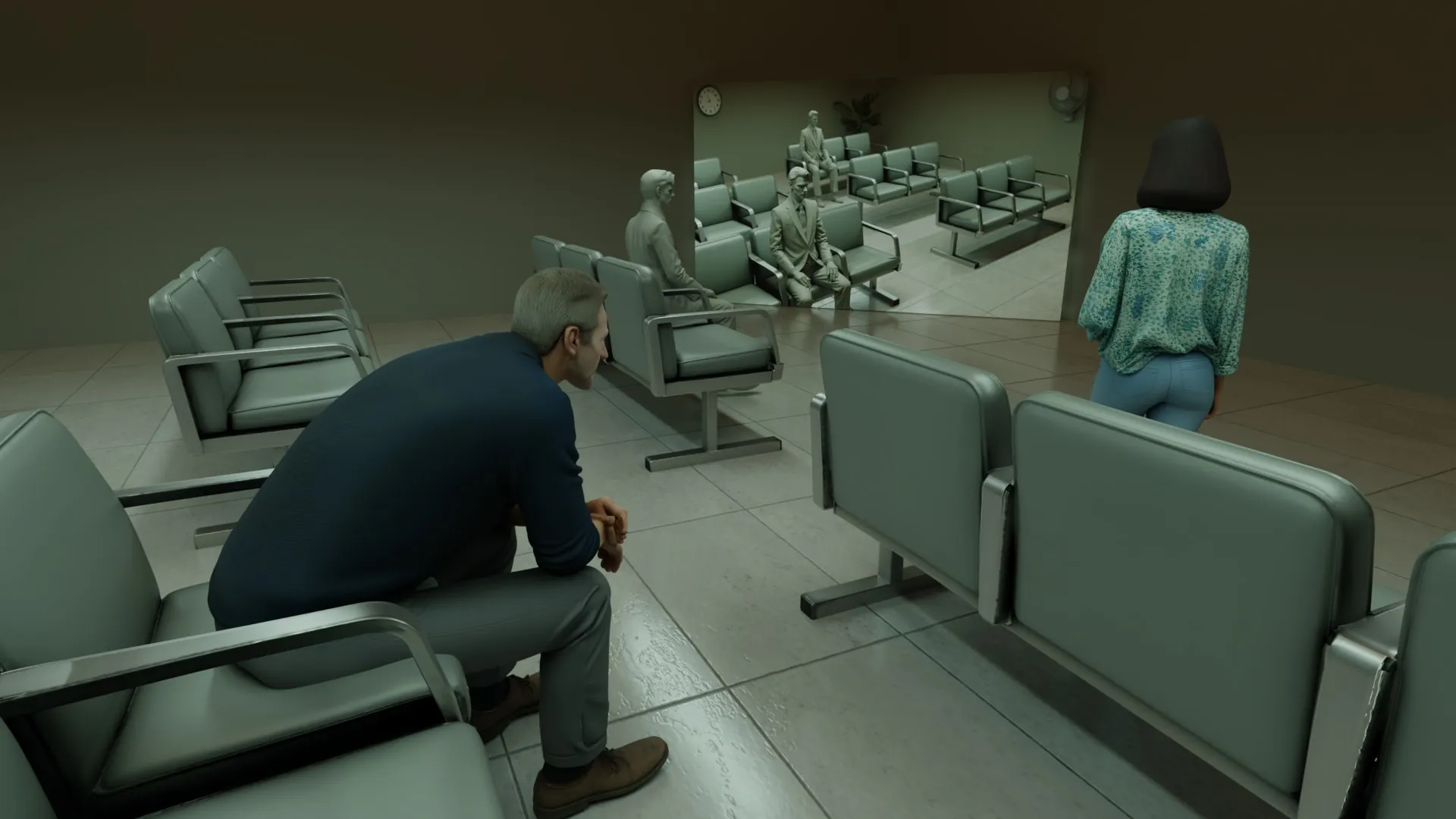
Conditional is an ongoing series of installations built on one premise, a mirror that erases you. A screen shows the scene in front of it, the fan turning, the clock ticking, everything rendered faithfully and in real time, except the people. You are there, and the screen is showing the place without you.
The screen is not showing a recording of the empty room played back. The system uses real-time generative AI to actively imagine what the scene looks like without you, producing your absence frame by frame. The world on screen was never photographed empty, it is being invented, continuously, to not include you.
Each staging sets the conditions of that erasure differently and is developed as its own work. Two stagings are in development now, The Mirror and The Waiting Room.
The problem with technology used to be surveillance, now the problem is that it doesn’t see you at all.
Conditions
Every staging of Conditional answers the same questions in its own way. Do you vanish the moment you arrive, or fade slowly enough to watch yourself go? Can you return at all, and at what price? And what is it that returns, you as you are, a color-corrected version the scene will accept, a figure closer to a mannequin than a person, or nothing?
These are not settings on a finished work, they are the questions the series exists to test. Each staging is developed for its context and sets the conditions for that site. The two stagings below are the first answers.
The Mirror
Working title · first physical prototype in build · 2026
A screen disguised as a framed mirror, hung where a mirror would hang. You walk up expecting your reflection, and at first you get it, but then the system slowly removes you, and nothing you do returns you. Here the conditions are absolute.
A mirror has one job, to show you. A mirror that renders the room faithfully and leaves you out breaks a contract older than any technology. Across a day the reflection empties of people even as the room fills, until by closing time the mirror shows a place no living person is in.
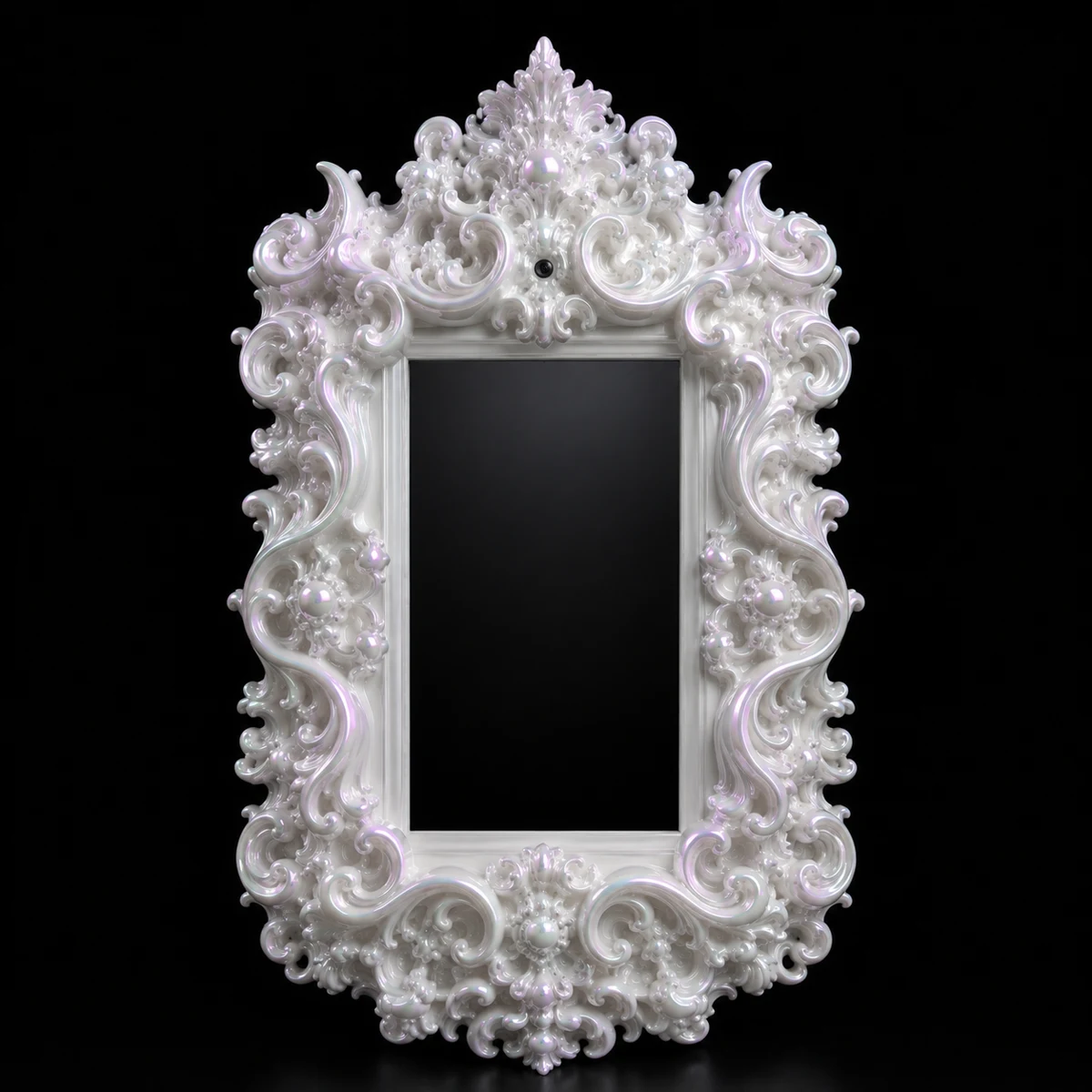
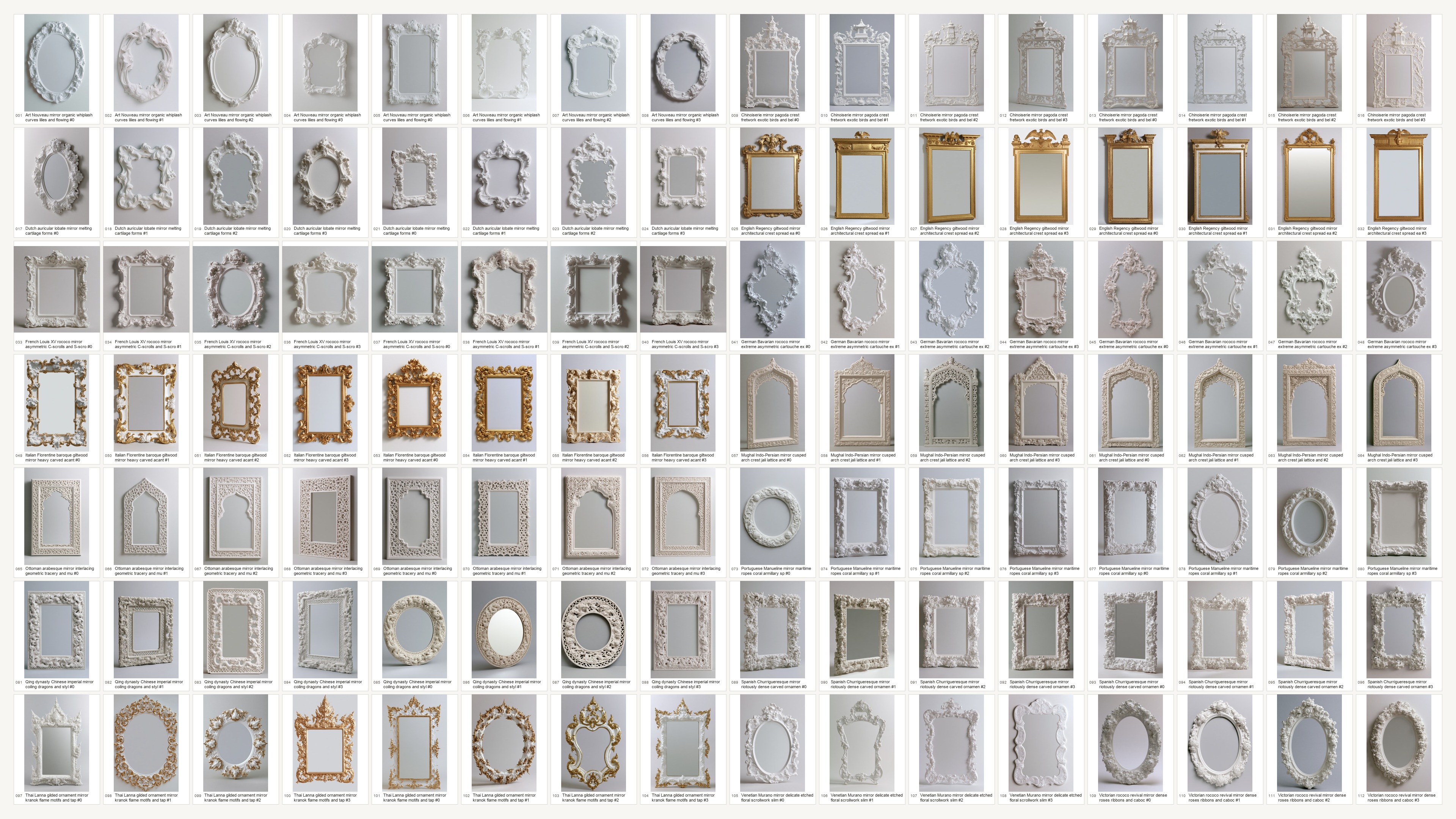
The frame is part of the work, not a decoration around it and its final form is being generated rather than chosen. A model composes across the whole category of ornate mirrors at once, so the frame reads as grand and ornate from across the room and settles into no real period or tradition as you come closer. It is the machine’s idea of a mirror rather than any mirror that has existed, made by a system that knows the category well enough to render it grand and never well enough to make it real.
That is the logic the screen already runs on the viewer, recognized closely enough to be removed and never closely enough to be kept. The white baroque frame shown here is a stand-in while that form is developed, a placeholder for the prototype and not the final object.
The Waiting Room
In development · 2026
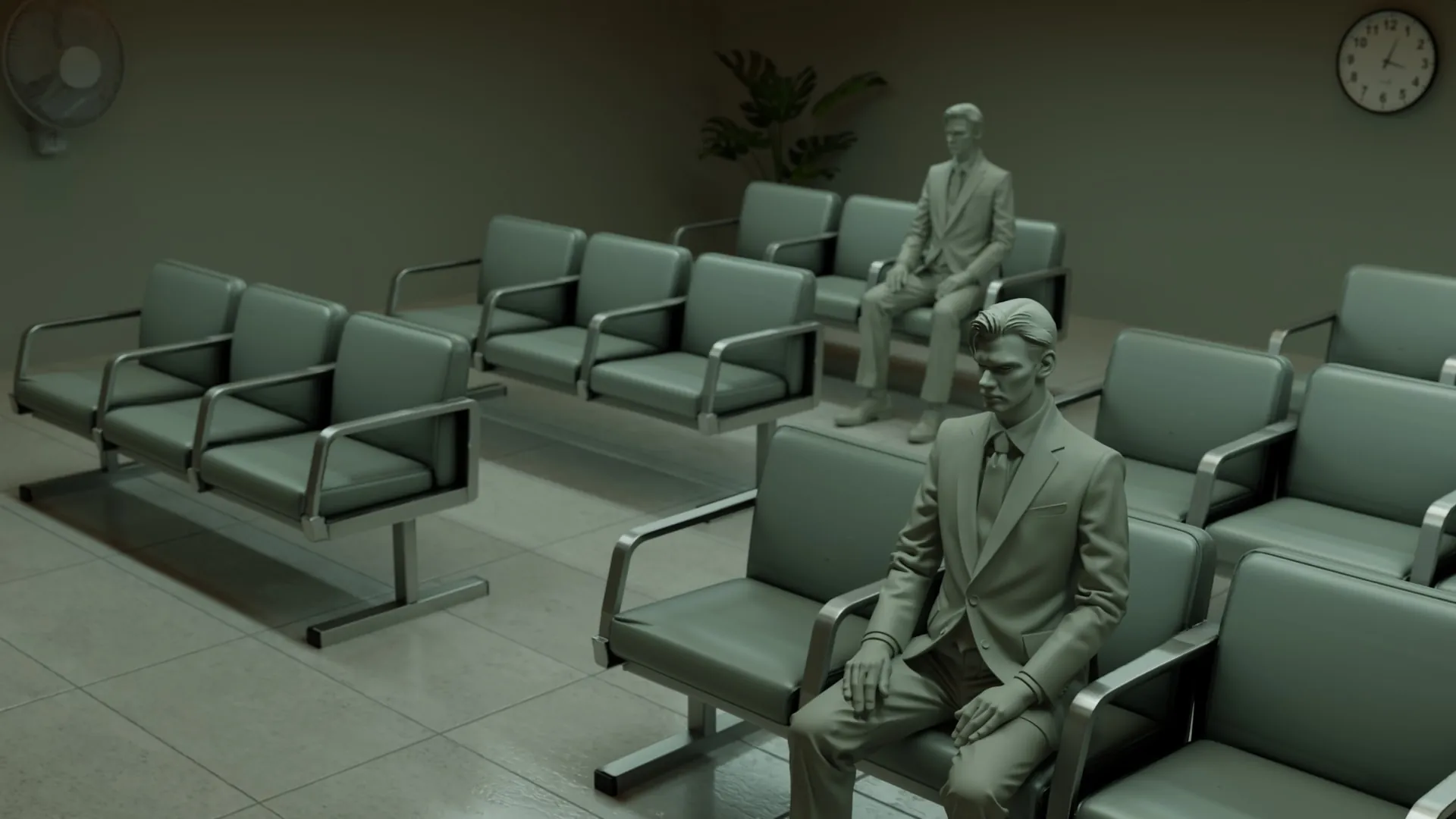
An institutional waiting area, chairs in rows, suited mannequins, a ticking wall clock, an oscillating desk fan. The kind of space that already asks you to sit down and wait. Here the conditions are negotiable. You vanish on arrival, and if you hold still you begin to reappear, not fully, your colors shifted to match the palette of the scene. What returns is a version of you the room will accept. Move again, and you’re gone.
The mannequins were always visible, they never had to do anything. The living body has to earn what the mannequins were given by default.
When there are multiple people in the room, everyone can see who’s trying to comply and who isn’t. Someone across the room is holding still, slowly resolving into a color-shifted version of themselves. They can see you deciding whether to do the same. The negotiation between visibility and self-compromise is happening live, between strangers, and the screen is showing all of it.
This staging produces a series of editioned prints computed from the system’s compliance data. During a structured day-long session, fifty participants arrive whenever they choose and stay as long as they like. Additional cameras capture their activity from multiple angles and generate long-exposure composites. Bodies that held still appear sharp and defined. Bodies that moved are smeared across the image. The prints are the system’s record of who complied and who didn’t, and they can be exhibited independently.
Still thinking
I do not have answers to most of this yet, and that is part of why the work keeps splitting into new pieces. These are the questions I keep turning over while I make it.
What does it feel like to stand in a room and not show up in it? When is being invisible a relief, and when does it start to hurt?
A mirror has one job, to show you. So what happens to the small daily habit of glancing at one to check you are still there, when the mirror leaves you out? And when did looking at yourself and performing yourself for everyone else become the same thing?
By the time you are an adult standing in front of a mirror, the agreement between your body and its reflection is not something you think about. Your hand lifts, the reflection lifts. The Mirror does not just break that agreement, it suspends it. It is a decision that you are not shown.
There is a version of The Mirror with a small mark on you in the frame, and you only notice it if you come close. You approach to look, and stepping closer is stepping into the zone where the mirror removes you completely. What you went looking for disappears the moment you arrive. This is in reference to how the Mirror Self-Recognition test was done with chimpanzees, to see if they’re able of visual self recognition.
How much of ourselves do we hand over just to be let back in, online and most other places too? Why does being recognized feel like such a basic need, and why do we offer a tidier, more acceptable version of ourselves to get it?
There is also the plain question of whether the machine sees us at all. It can pick a person out well enough to remove them and invent the space they leave, and still never know who they are. Is that recognition, or only a number standing in for a face?
Every day most of us make dozens of small transactions to stay visible online. We tick boxes, allow cookies, hand over location and none of these feel like decisions. They are too fast. There is no physical experience of giving anything away. The work makes the same transaction happen in a room, with your body. You can watch yourself decide to comply. The system has everything it would need to track you, and it uses that data exclusively to disappear you. Whether that makes it a dictator or a guardian is not a question the work settles.
And the one that stays with me. Why does being more connected than ever leave so many people feeling unseen? The old worry was being watched too much. The newer one is being looked straight through.